

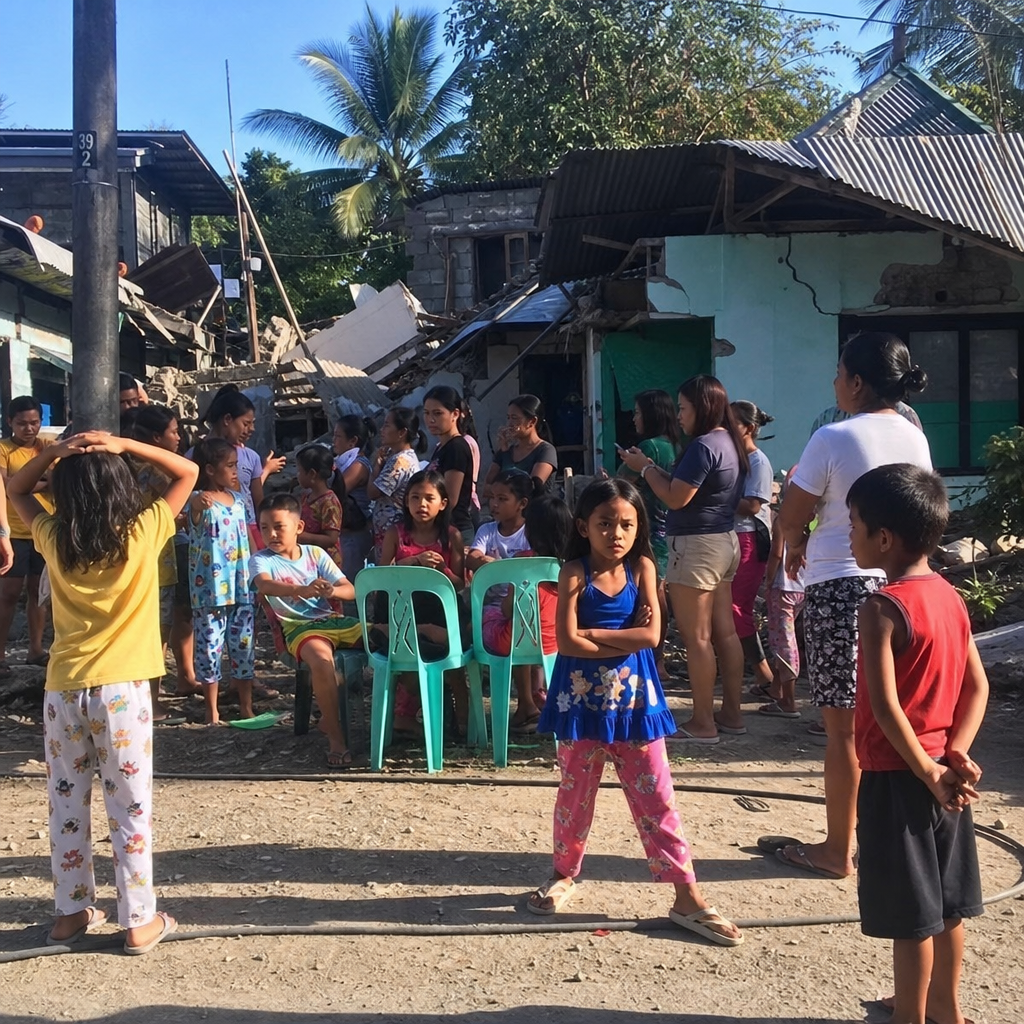
A series of powerful earthquakes rocked the southern Philippines this week. The tremors caused severe damage in Mindanao. Homes and buildings collapsed. Roads cracked open. Families got displaced.
The first quake struck early on Thursday. This registers a magnitude of 6.3. It hit near Maragusan, a town in Davao de Oro. Officials reported this as one of the strongest quakes in recent memory. "Many homes and buildings are damaged," a local official said. "We fear more aftershocks."
Residents scrambled to safety as buildings shook more. Some people raced outside in panic. "We never felt anything like this," a survivor said. "It's terrifying."
Emergency responders quickly arrived. They provided aid and searched for survivors. The local government arranged temporary shelters. Food and water flowed to affected areas. "Our priority is to ensure safety," the mayor stated. "Shelter and aid for all is key."
The tremors highlighted the Philippines' vulnerability. The country sits on the Pacific Ring of Fire. It experiences regular seismic activity. Experts warn of constant threats. "Earthquakes are inevitable here," a seismologist warned. "Preparedness is essential."
Lack of earthquake-proof infrastructure worsens the impact. Many structures remain unsafe. People urged the government to improve building codes. "Buildings need better standards," a civil engineer noted. "Lives depend on it."
Rebuilding will take time. Residents brace for more aftershocks. Already, engineers assess damages. The goal is to reinforce weak structures. Rebuilding hopes to start soon.
The government plans further assessments. Aid organizations mobilize efforts. Communities unite in this crisis. "We will recover from this," a survivor declared. "We are resilient." Emergencies continue management.